Introducing AI into legacy code repositories can accelerate development, but it also increases the risk of misunderstood architecture, hidden dependencies, and incorrect assumptions being turned into production-ready code. This article explores why mature codebases are harder for AI to navigate, why senior oversight matters, and how organisations can use AI safely without letting speed outrun understanding.
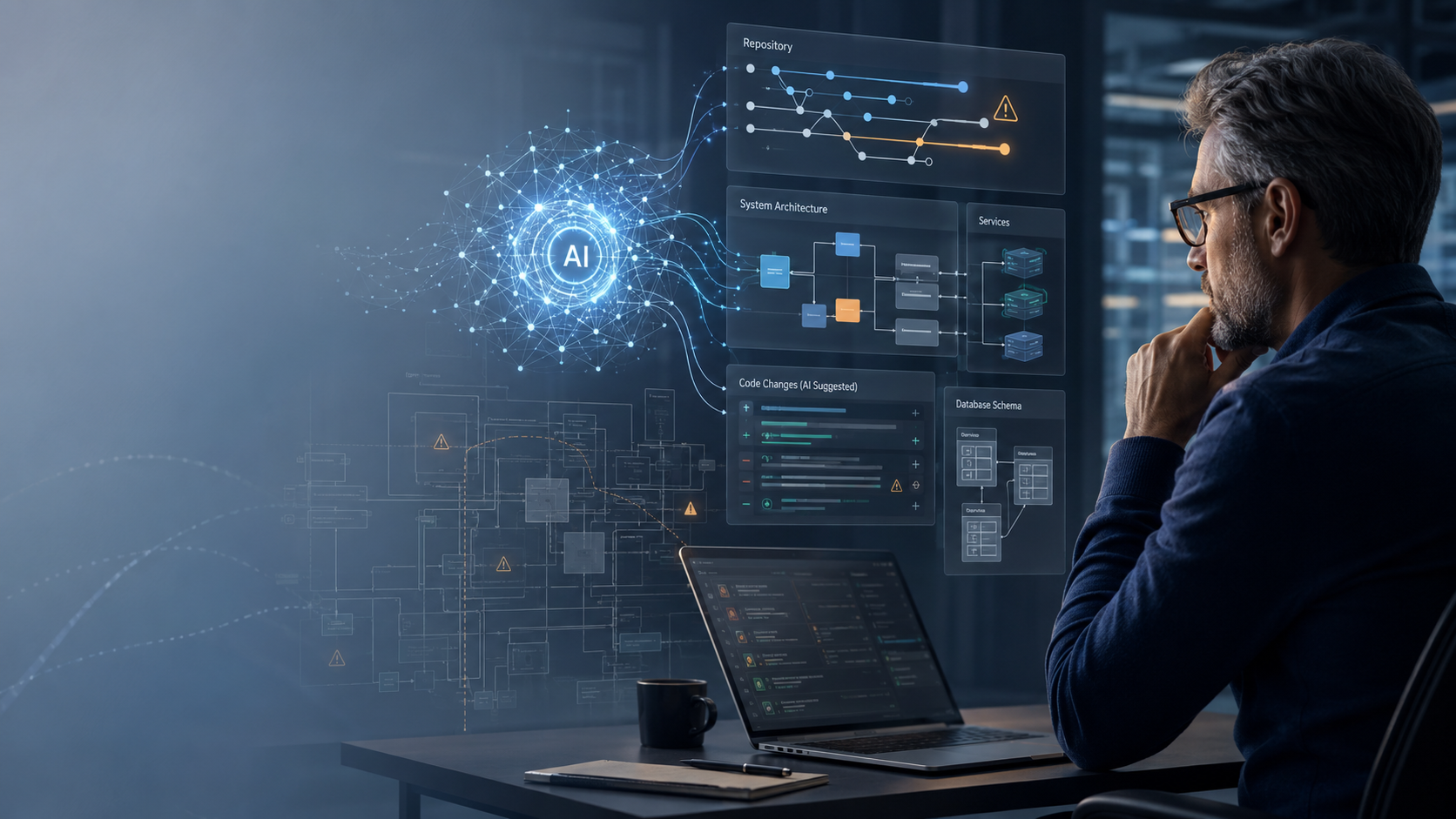
AI-assisted coding is moving quickly from experimentation into day-to-day software delivery.
Teams are using copilots, chat-based assistants, code generation tools, and automated reviews to speed up development, reduce repetitive work, and help engineers move faster across unfamiliar code.
But when AI is introduced into a legacy code repository, the challenge is rarely just about whether the generated code compiles.
The real issue is this:
That matters because legacy repositories are not simply collections of old code. They are living systems shaped by years of technical decisions, production incidents, business constraints, integrations, workarounds, and architectural trade-offs.
Without that wider understanding, AI can become very effective at extending patterns it does not fully understand. Below is an exploration of why this matters, what can go wrong, and how organisations can use AI safely in established codebases.
In theory, AI reads the repository and uses that context to generate changes.
In practice, legacy systems contain a great deal of meaning that is not fully visible in the source code alone.
That hidden context often includes:
This is where teams can get caught out.
A piece of generated code may match the style of the repository, pass basic tests, and still be wrong because it has misunderstood the intent behind the code it is modifying. In legacy environments, correctness is not just about syntax or functionality. It is about fitness within a wider system.
One of AI’s greatest strengths is pattern recognition. It can look at nearby code, infer conventions, and generate something that appears consistent with the rest of the implementation.
But legacy systems are rarely consistent because they were not built all at once, by one team, under one set of assumptions.
They have evolved.
That means code often looks a certain way for reasons that are not obvious from the file itself. A slow query may exist because a faster version caused locking issues in production. A duplicated validation rule may remain because a shared service cannot yet be changed. An awkward-looking interface may support an external consumer that has not been modernised. A retry pattern may be avoided because of duplicate processing risk downstream.
From the model’s perspective, these can look like problems to clean up. From the organisation’s perspective, they may be deliberate guardrails.
This creates a dangerous mismatch:
This becomes even more important when less experienced engineers use AI in complex repositories.
If a junior engineer only partially understands the code, they may prompt for a change based on what appears to be the problem rather than what is actually causing it.
For example:
These prompts can seem reasonable.
But if the person writing the prompt does not understand the wider architecture, the AI will make assumptions based on limited context and present those assumptions back as polished code.
That is where risk compounds.
The engineer may not know what context is missing.
The AI may not know which architectural questions need to be asked.
The generated output may look authoritative.
And the reviewer now has to detect not only implementation issues, but also hidden misunderstandings.
In effect, AI can turn uncertainty into confidence without reducing the uncertainty itself.
AI often performs better in greenfield or tightly scoped environments because the problem is simpler. There are fewer dependencies, fewer inherited patterns, and fewer hidden constraints.
The question is often:
Does this work?
Legacy repositories introduce a much harder question:
Does this work without breaking everything else the organisation already relies on?
That includes:
In other words, a legacy codebase is not just software. It is accumulated organisational memory. AI can help navigate that memory, but it does not automatically understand it.
A lot of AI debate focuses on code quality. That is important, but it is not the main issue in mature systems. The more serious risk is assumption failure. Generated code can be clean, readable, and technically competent while still being based on the wrong interpretation of the problem.
That might lead to:
These are exactly the kinds of failures that are hardest to spot quickly and most expensive to unwind later.
This is why experienced engineering oversight becomes so important. Senior engineers are not valuable simply because they can write code faster. They are valuable because they understand the system around the code.
They are more likely to recognise:
This is also why organisations are increasingly cautious about treating AI-generated code as “done” simply because it looks complete. In complex repositories, human review is not just a governance step. It is the mechanism that reconnects the change to architecture, intent, and accountability.
None of this means AI should be excluded from legacy repositories. It means it should be used with clear boundaries. The most effective use cases are usually those where the scope is narrow and the hidden context is limited.
AI tends to be most useful for:
It becomes riskier when used for:
The goal should not be to prevent engineers from using AI. The goal should be to ensure that speed does not outrun understanding.
AI can absolutely help teams move faster in established codebases. But speed only creates value when it is grounded in understanding. Legacy repositories are difficult because they contain years of decisions, constraints, and trade-offs that are only partly visible in the code itself.
That is why introducing AI into these environments requires more than tooling.
It requires:
The real lesson is simple:
And in legacy systems, that meaning is never fully captured in the code alone.
Used well, AI can accelerate delivery.
Used carelessly, it can scale misunderstanding.
The organisations that succeed will be the ones that treat AI as an assistant to engineering judgment — not a replacement for it.



.png)
.jpg)
.jpg)